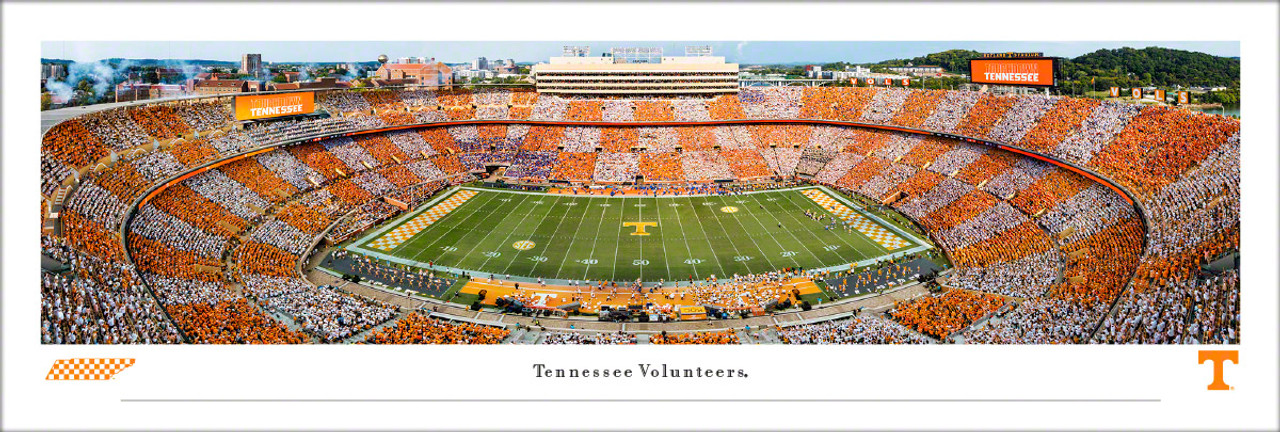
From the moment you arrive within earshot of Neyland Stadium, you know you are in Volunteer country. While it may be easy to become distracted by the beauty of the nearby Smoky Mountains and the peaceful flow of the Tennessee River beside the stadium, the excitement quickly returns as more than 100,000 fans rise to their feet to cheer on the Tennessee Volunteers. The anticipation reaches its peak as the team runs onto the field through the marching band, positioned in the shape of the iconic letter “T,” across the trademark checkerboard orange and white end zones.
Like many of college football’s largest stadiums, Neyland Stadium began with humble beginnings. The history of the facility dates back to 1919 when W.S. Shields, a University of Tennessee trustee and president of a local bank, provided funding for a new stadium for the football program. Completed in 1921, the stadium was originally named Shields-Watkins Field in honor of Shields and his wife, Alice Watkins. The Volunteers played their first game at the new facility on September 24, 1921, defeating Emory and Henry. The original stadium is a far cry from the massive venue today. It featured a single-tier grandstand on the west side of the field with a seating capacity of only 3,200. The first expansion took place in 1926 when a new grandstand adding 3,600 seats was constructed. That same year, legendary coach Robert R. Neyland began his first tenure leading the Tennessee football program.
As the popularity of Tennessee football grew, so did the stadium. In 1929, an additional 11,060 seats were added on the west side, followed by 12,000 seats on the east side in 1938. By the 1948 season, seating had been added in the south end zone, increasing capacity to 46,390. In 1962, Shields-Watkins Stadium was renamed Neyland Stadium in honor of Coach Robert Neyland, one of the most successful coaches in college football history. Before the 1962 season, the first upper deck was constructed on the west side of the stadium, adding more than 17,000 seats and a modern press box while increasing capacity beyond 50,000. Additional expansions followed before the 1966, 1968, 1972, and 1980 seasons, eventually increasing seating capacity to 91,249. Artificial turf was installed in 1968 and remained until 1993, when the playing surface returned to natural grass.
Luxury seating became a major part of Neyland Stadium’s evolution. In 1987, 42 luxury suites were added, followed by another 78 suites before the 2000 season. The final major seating expansion occurred before the 1996 season when 10,642 seats were added to the north upper deck, bringing capacity to 104,544.
In 2004, the University of Tennessee approved a $200 million master plan to renovate Neyland Stadium in five phases. The first phase, completed in 2006, focused on improvements to the east side of the stadium, including new club seating and premium areas, reducing capacity slightly to just under 102,000. The second phase, completed before the 2009 season, renovated the west side with upgraded skyboxes, press facilities, club areas, expanded concourses, new restrooms, and improved concession areas. This phase also included the installation of a 4,000-square-foot HD video board. The third phase was completed before the 2010 season and introduced the Tennessee Terrace, featuring 1,800 club seats, improvements to Gate 21 Plaza, and a new brick exterior façade. Today, Neyland Stadium has a seating capacity of 101,915 and remains one of the largest stadiums in college football.