ROSE BOWL STADIUM
|
|
 |
PASADENA, CA
|
|
|
|
-Bowl Game:
Rose Bowl
-Sponsor: Northwestern Mutual
-Capacity: 91,136
-Surface: Grass
-Opened:
January 1, 1923
-Host Since 1923
-Cost: Unknown
-Seating Chart
-Rose Bowl Website |
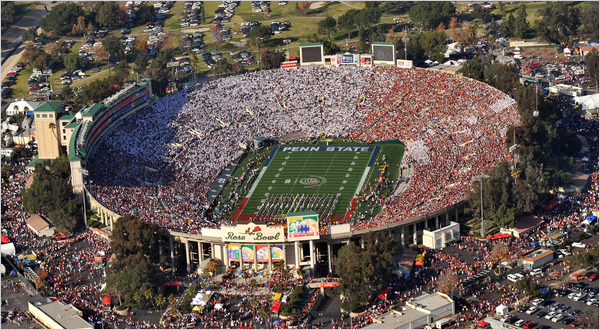
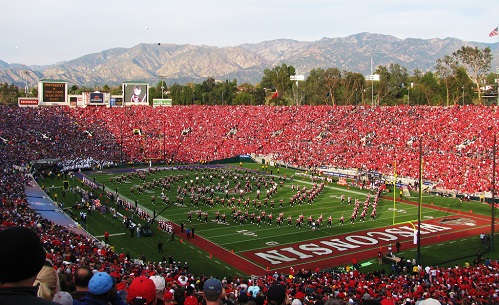
Referred to in sports as the "Granddaddy of Them
All" because of its prestige and tradition, the Rose
Bowl stadium is most famously known for hosting the
annual Rose Bowl Game on New Year's Day.
The Rose Game will no longer match teams from the
Pac -12 and Big Ten conferences.
The game is now part of six bowl games
that will host two semifinal college football
playoff games on a rotating basis, including the
2015 game. Years that the bowl does not host a
semifinal playoff game, the Rose Bowl Game will
feature College Football Playoff matchups.
In
the late 1800s, the City of Pasadena
begin their search for land to build a stadium. In 1897, a parcel of
land was bought and two decades later, the Tournament of Roses
Association decided it was time to build a stadium. Before the
construction of the Rose Bowl, the annual Rose Bowl game was played at
Tournament Park, where temporary stands were constructed each year for
the game. Construction on
the stadium began in the early 1920s and was complete in 1922. Built
just for football, the first game played at the Rose Bowl was
on October 28, 1922 when Cal beat USC. The Rose Bowl originally had a
seating capacity of 57,000 in a horseshoe configuration. On January 1,
1923, the first Rose Bowl Game was played when USC beat Penn State.
The first of several expansions to the Rose Bowl
began in 1929,
when the stadium was enclosed on the south end, increasing the capacity
to 76,000. Three years later, the capacity increased again to 86,000
and to just over 100,000 in 1949. In 1982, the UCLA Bruins made their
debut at the Rose Bowl, moving from the Los Angeles Coliseum. Since then, it has remained the
Bruins home
and the site of many other events. In the past decade, the Rose Bowl has
underwent
several improvements including new lights, a new three story press
box and a video/scoreboard. In 1998, individual chairs replaced the
bleachers between the endzones. In October 2010, the Pasadena City
Council approved plans for a $140 million renovation
of the Rose Bowl. This project includes a new 30 x
77 foot video/scoreboard, expansion of the seven
level Terry Donahue Pavilion, renovation of the
famed entrance, updating the concourses and
restrooms, and the removal of a section of seating
near the field to all the addition of hedges on the
west sideline. Today the Rose Bowl has a seating
capacity of between 92,000 to 94,000. The main one
tier grandstand encloses the entire playing field.
In addition to hosting numerous college football
games over the years, the Rose Bowl has been home of
the Super Bowl and the World Cup. Of course it is
most famous for hosting the Rose Bowl each year on
New Years Day.
|
|
|
|
|
|
|
|
|
|
MAP & DIRECTIONS TO THE ROSE BOWL
|
|
Address:
1001 Rose Bowl Drive, Pasadena, CA 91103
|
|
|
|
|
|
HOTELS NEAR THE ROSE BOWL
|
|
|
|
|