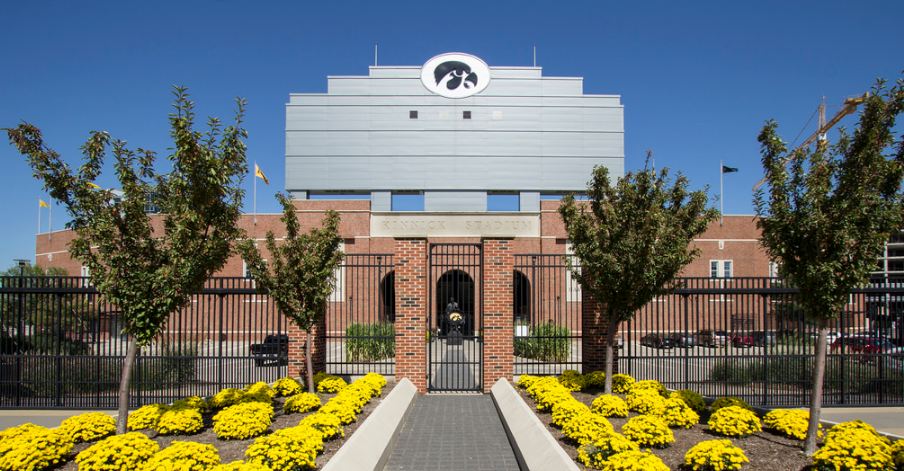
Opening in 1929, Kinnick Stadium has welcomed fans from across Iowa who flock to see the Hawkeyes each fall. Football became a varsity sport at the University of Iowa in 1889, and in 1900 the Hawkeyes joined what would eventually become the Big Ten Conference. By the early 1920s, the Hawkeyes had established themselves as one of the top teams in the country, winning back to back Big Ten championships under Hall of Fame coach Howard Jones. As the team’s success on the field continued to grow, so did the need for a larger football stadium.
In March 1929, construction began on a new football stadium. Completed just seven months later, the Hawkeyes played their first game at Iowa Stadium on October 5, 1929, against Monmouth College. The stadium originally had a seating capacity of 53,000, making it one of the largest college football stadiums in the country at the time.
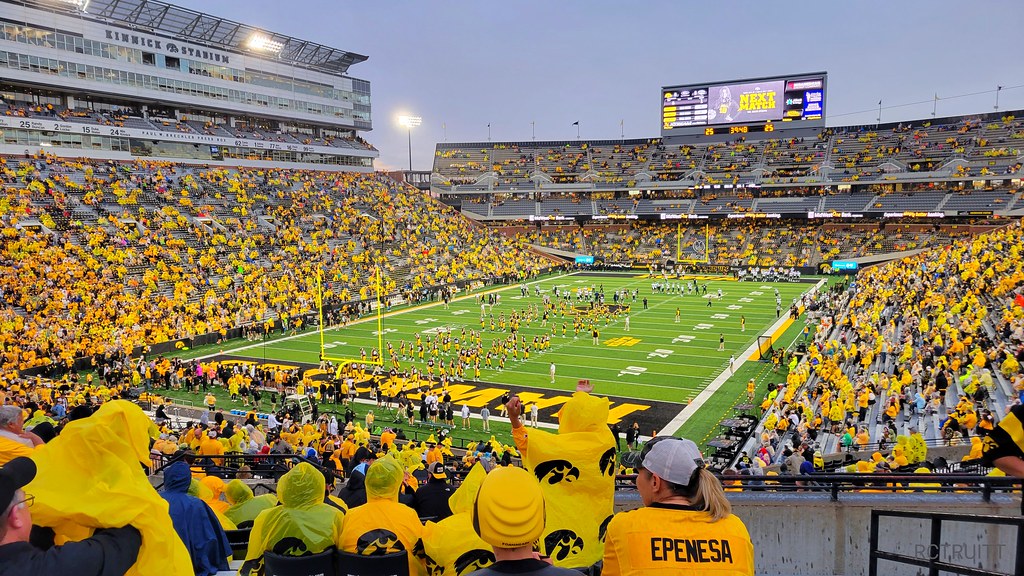
Originally known as Iowa Stadium, the facility received its current name, Kinnick Stadium, in 1977 after sportswriter Gus Schrader lobbied for the stadium to be named after Nile Kinnick, Iowa’s only Heisman Trophy winner. Several expansions have taken place at Kinnick Stadium throughout its history. A grandstand was added in the south end zone in 1956, and the north end zone was enclosed in 1983, increasing the seating capacity to 66,000. In 1997, a new video scoreboard was added to the stadium. In 2006, more than $86 million was spent on renovations that included a new press box, a new video scoreboard, the replacement of the temporary south end zone bleachers with permanent seating, and additional restrooms and concession areas. Prior to the start of the 2013 season, new HD video boards were installed in both end zones.
The most recent major renovation at Kinnick Stadium was completed in 2019. The nearly $90 million project included additional box and outdoor club seating, along with a larger videoboard in the south end zone. Today, Kinnick Stadium has a seating capacity of just over 69,000. While most college football stadiums intimidate opposing teams because of their size and game day atmosphere, Kinnick Stadium is also famous for something found inside the stadium, its pink visitors locker room.
One of the newest and most special traditions in college football began at Iowa in 2017. The University of Iowa Stead Family Children’s Hospital opened that year and overlooks the east grandstand at Kinnick Stadium. Many patients are able to watch the game from a top floor lounge overlooking the field. At the end of the first quarter, the entire crowd turns toward the hospital and waves to the patients. Everyone throughout the stadium participates in what has become known as the “Kinnick Wave.”
The tradition has become one of the most emotional moments in college football. For a few minutes each game, more than 69,000 fans put aside the competition on the field to acknowledge the children watching from the hospital. The Kinnick Wave has become a defining tradition of Iowa football and a powerful reminder that college football can be about much more than the game itself.