Traditions and mascots are an important part of the game day experience across college football. However, there may be no tradition as unique as the one found at each Florida State game at Doak Campbell Stadium. Before the start of every game, the FSU crowd erupts as Chief Osceola, a student portraying the famous Seminole leader, rides onto the field on an Appaloosa horse named Renegade. Once he reaches midfield, Chief Osceola rises up and plunges his flaming spear into the field. This is just one of the many traditions fans can experience at Doak Campbell Stadium, home of the Seminoles since 1950.
Compared to many other universities, Florida State has a relatively young football program. Intercollegiate football began at Florida State in 1947, and the Seminoles played at Centennial Field for three seasons. A new stadium was constructed for the team before the 1950 season and named after former Florida State President Doak S. Campbell. With an original capacity of 15,000, consisting of seating on both sides of the field, the Seminoles played their first game at the stadium on October 7, 1950, against Randolph Macon.
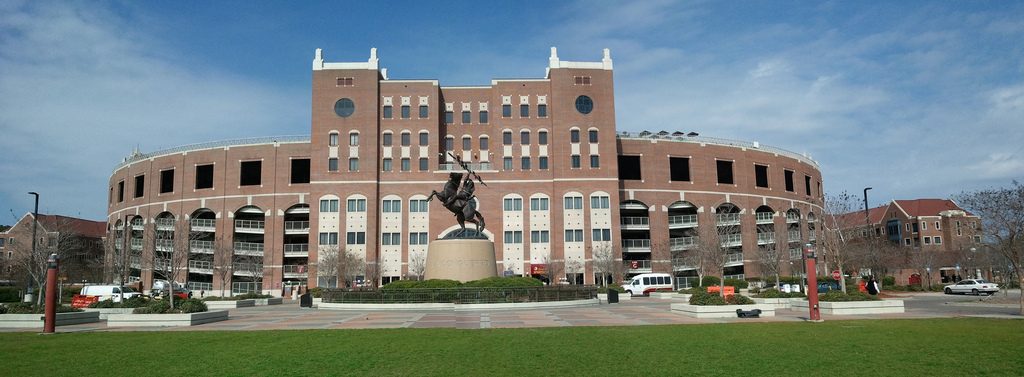
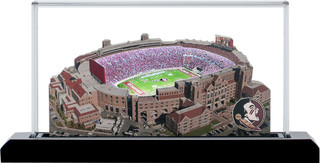
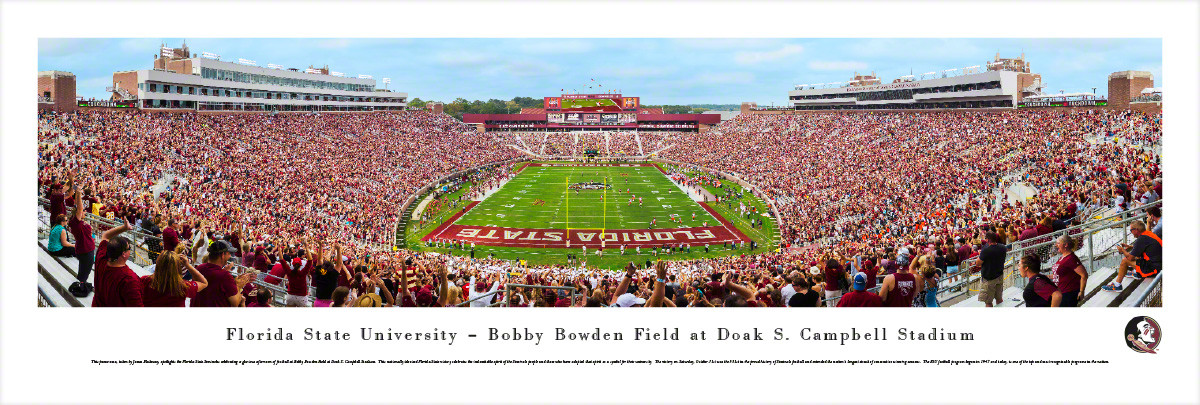
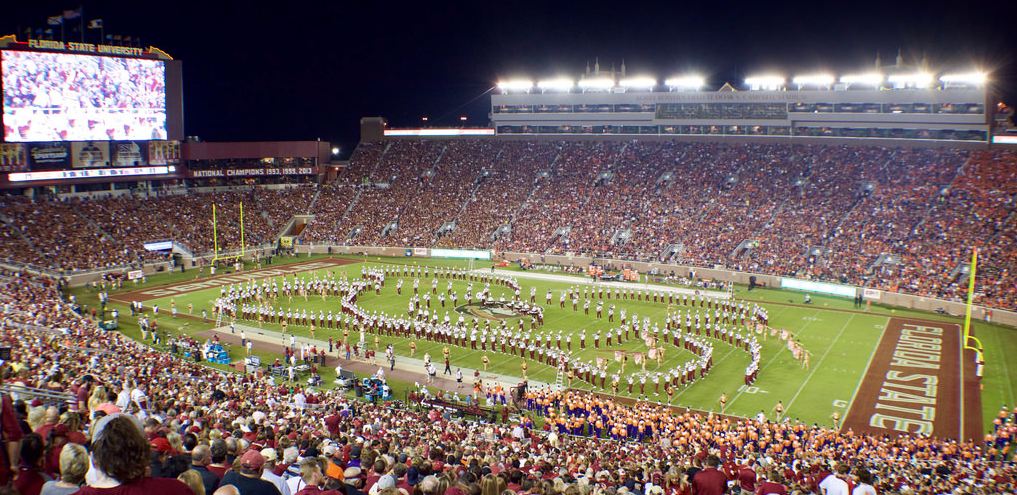
Since opening more than seven decades ago, Doak Campbell Stadium has grown from a small facility into one of the most recognizable football stadiums in the nation. As fan support increased, the stadium was expanded several times. Expansions in 1954, 1961 and 1970 increased the seating capacity to 40,500, followed by additional expansions in 1982 and throughout the 1990s that increased capacity to more than 82,000. Today, an enormous single tier grandstand encloses the entire field. A facility on the south end zone contains a food court, restaurant and sports grill, while football offices are located along the rim of the north end zone overlooking the field. Luxury suites and the press box are also located along the rim of the stadium. Two HD video scoreboards are positioned above the stands in each end zone. Outside, the stadium’s brick façade helps it blend naturally with the surrounding campus. On November 20, 2004, the field at Doak Campbell Stadium was named after legendary Florida State coach Bobby Bowden. The facility is now officially known as Bobby Bowden Field at Doak Campbell Stadium.
Doak Campbell Stadium was expanded slightly before the 2016 season with the addition of the Champions Club in the south end zone. This club seating addition was part of a larger $280 million athletic expansion and improvement project completed by 2018. The project slightly reduced the overall seating capacity to 79,560. Following the 2023 season, the Seminoles began a $265 million transformation project at Doak Campbell Stadium. Completed before the 2025 season, the project included improvements throughout the stadium, with the primary focus on the east and west sides. New and wider seating was added, along with luxury and premium seating areas for fans. The renovations reduced the seating capacity to 67,277.
Doak Campbell Stadium is known as one of the most intimidating places for opposing teams to play. The passionate atmosphere has helped make Florida State one of the most successful programs in college football, with the Seminoles winning three national championships and 17 conference titles.