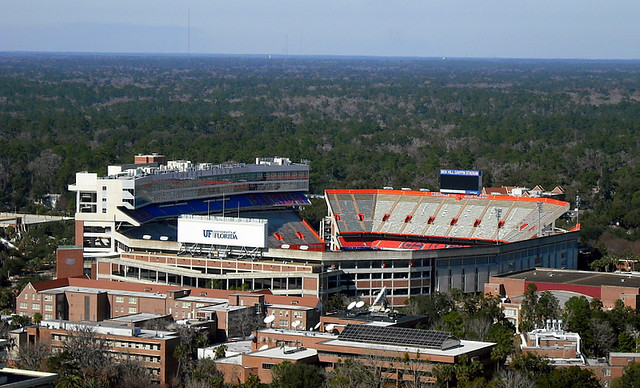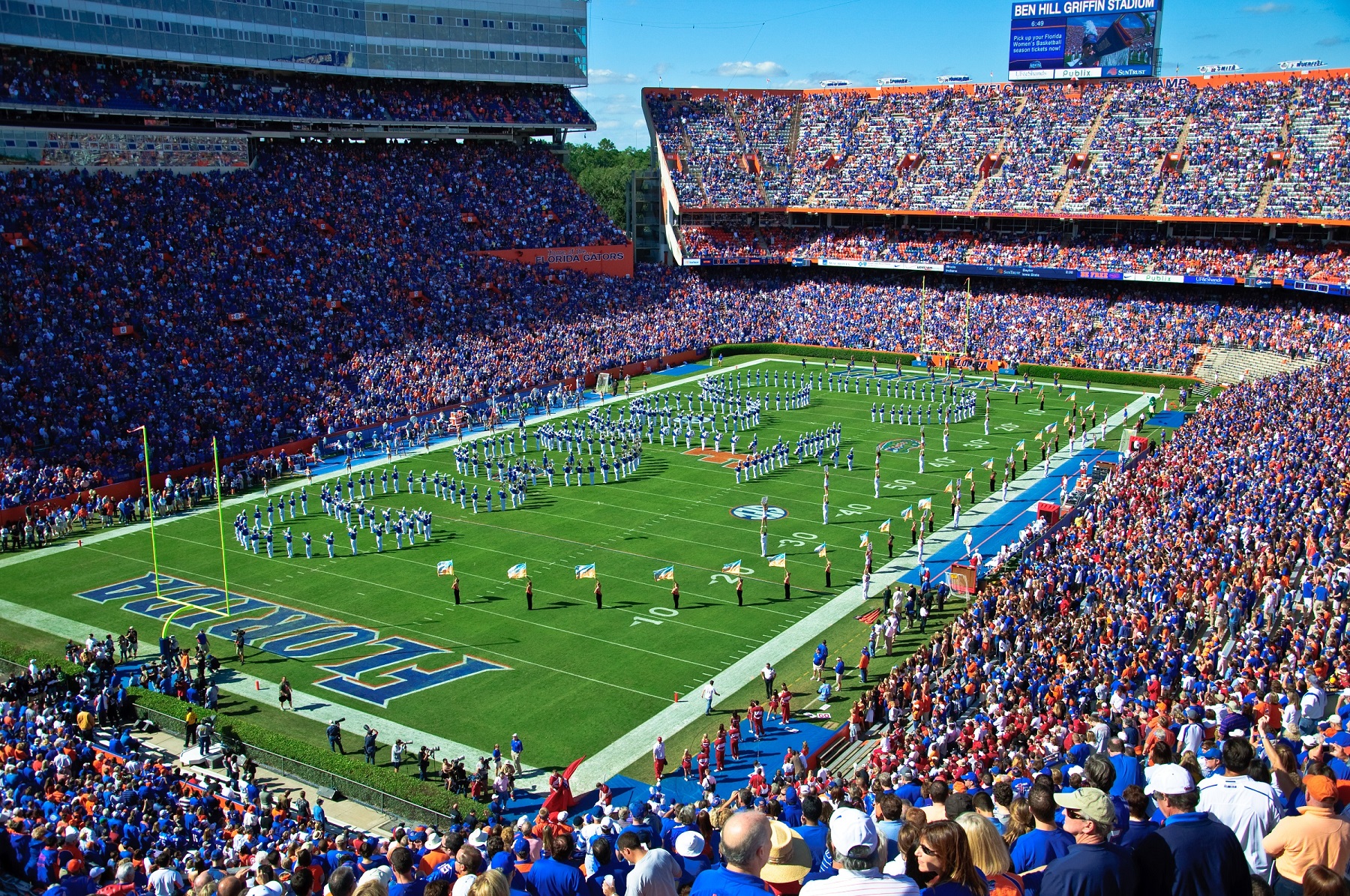
“Heeeeeeeeere come the Gators!” is one of the most recognizable traditions in college football, echoing throughout Ben Hill Griffin Stadium, better known as “The Swamp.” Located on the campus of the University of Florida in Gainesville, the stadium has long been one of the most intimidating venues in the nation, where deafening crowds and sweltering temperatures create one of the toughest home-field advantages in college football.
Florida’s football history began in 1906 when the Gators played at Fleming Field. As the program’s popularity grew during the 1920s, university officials recognized the need for a larger, permanent home. University President John J. Tigert championed the effort to build a modern football stadium, and construction began on April 16, 1930. Just over six months later, the stadium was completed, and on November 8, 1930, Florida Field was officially dedicated as the Gators hosted Alabama. The original stadium seated 21,769 fans and was named Florida Field in honor of the servicemen who lost their lives during World War I. That original seating bowl remains the foundation of today’s stadium, forming much of the lower level.
As Gators football popularity continued to grow, so did the stadium. The first major expansion came before the 1950 season when 10,000 bleacher seats were added along the west sideline. That same year, the Gators played their first night game at Florida Field on September 23. Fifteen years later, another 10,000 seats were constructed on the east side, while additional bleachers in the south end zone increased the stadium’s capacity to approximately 62,800. In 1971, the natural grass playing surface was replaced wit AstroTurf, though the artificial surface was removed two decades later in favor of natural grass. Additional renovations throughout the 1980s included the construction of a new south end zone featuring skyboxes and a modern press box, increasing capacity to more than 72,000. In 1989, the stadium was officially renamed Ben Hill Griffin Stadium at Florida Field in honor of longtime University of Florida supporter and benefactor Ben Hill Griffin Jr. Just two years later, a $17 million expansion enclosed the north end zone, raising capacity to more than 83,000 spectators.
The stadium underwent another significant transformation before the 2003 season with a $50 million renovation of the press level. The project expanded the press facilities while adding 2,900 club seats and 34 luxury suites. Today, Ben Hill Griffin Stadium seats 88,548 fans, making it the largest football stadium in the state of Florida. Multiple tiers of seating completely surround the playing field, creating the enclosed environment that has made “The Swamp” famous. In 2009, new high-definition video boards replaced the original scoreboards in both end zones, further enhancing the fan experience.
Outside the stadium stand bronze statues honoring Florida’s three Heisman Trophy winners, Steve Spurrier, Danny Wuerffel and Tim Tebow. The statues were unveiled in April 2011, and five years later, in June 2016, the university further honored Spurrier by renaming the playing surface Steve Spurrier-Florida Field at Ben Hill Griffin Stadium, recognizing the winningest coach in program history.
In June 2026, the University of Florida announced an ambitious $1.45 billion renovation plan that will begin following the 2027 football season. Scheduled for completion by 2030, the multi-year project includes the renovation of all 32 existing luxury suites, construction of 63 new suites atop the east side of the stadium, new video boards, wider concourses and aisles, a north end zone party deck, and approximately $500 million in deferred maintenance improvements. Although seating in portions of the lower bowl will be reduced, the addition of premium seating will allow the stadium’s overall capacity to remain virtually unchanged.
For decades, Ben Hill Griffin Stadium has been one of college football’s most feared venues. The Gators have enjoyed remarkable success at “The Swamp,” including a 30-game home winning streak from 1994 through 1999. Between the thunderous roar of more than 88,000 fans and field-level temperatures that often exceed 100 degrees, visiting teams quickly discover why Ben Hill Griffin Stadium has earned its reputation as one of the loudest and most intimidating stadiums in college football.