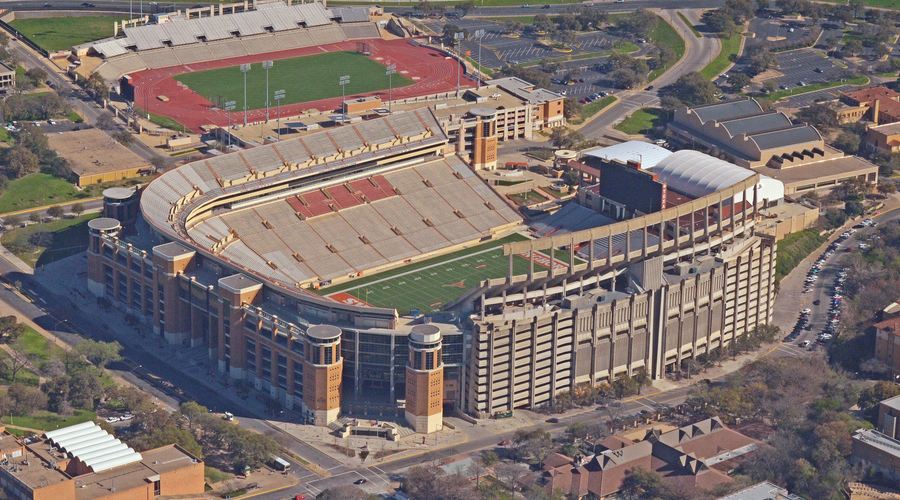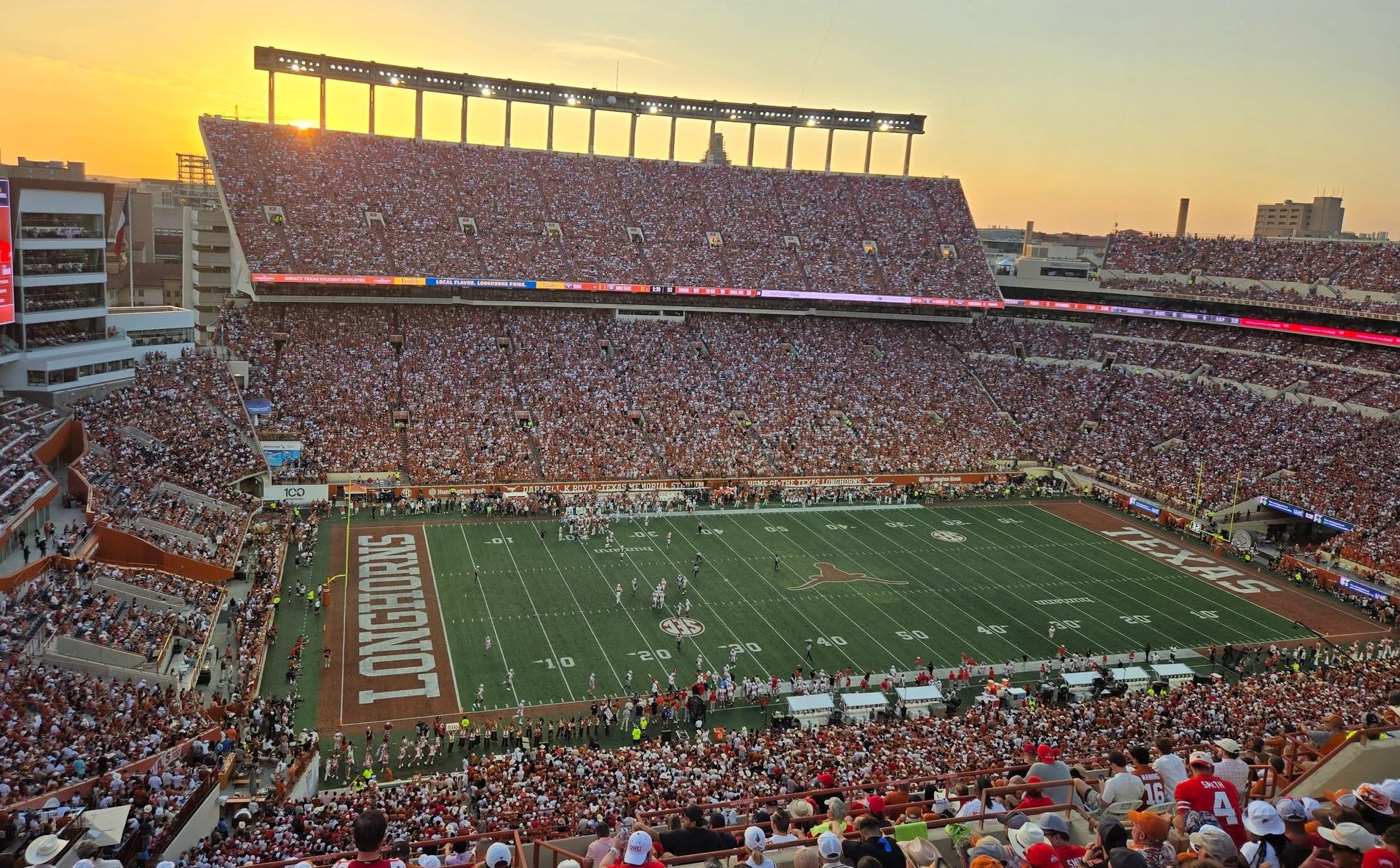
With a seating capacity of more than 100,000, the phrase “Everything is Bigger in Texas” applies to the home of the Texas Longhorns. Darrell K Royal–Texas Memorial Stadium has grown from humble beginnings into one of the largest and most recognizable college football stadiums in the country.
After playing for more than two decades at Clark Field, the University of Texas decided it was time to build a new stadium capable of accommodating the growing popularity of Longhorn football. Led by Athletic Director L. Theo Bellmont, the university began planning a new stadium in the early 1920s. Construction was completed in 1924, and the Longhorns played their first game at Memorial Stadium on November 8, 1924. Built at a cost of $275,000, the original stadium featured a seating capacity of 27,000.
As fan support continued to grow, Memorial Stadium underwent numerous expansions. Just two years after opening, the north side was expanded, creating the stadium’s original horseshoe configuration and increasing capacity to 40,500. By 1940, additional expansions included enlarged east and west grandstands and the construction of seating on the south side of the field, allowing the stadium to accommodate 60,000 fans. Modern upgrades continued throughout the decades. Lights were installed in 1955, and artificial turf replaced the natural grass playing surface in 1969. In 1971, the upper deck was added, further increasing the seating capacity and creating the iconic double-decked appearance of the stadium.
The 1990s brought a series of major improvements to the Longhorns’ home. In 1996, the playing surface was converted back to natural grass, a new video scoreboard was installed, and the stadium was officially renamed Darrell K Royal–Texas Memorial Stadium in honor of legendary Texas head coach Darrell Royal. The following year, 14 luxury suites were added on the west side, while a 5,000-seat upper deck and 52 additional luxury suites were completed on the east side in 1998. In 1999, the running track surrounding the field was removed and the playing surface was lowered three feet, allowing additional seats to be added closer to the action.
Following the 2005 season, the Longhorns installed one of the largest video boards in college football. The 55-foot-high by 134-foot-wide display in the south end zone became known as “Godzillatron” and quickly became one of the stadium’s most recognizable features. Temporary seating was added in the south end zone in 2006 and expanded the following season. A permanent 9,000-seat lower deck was added to the north end zone in 2008, followed by a north end zone upper deck completed before the 2009 season. This expansion added 2,000 club seats, 44 luxury suites, and a fan food court. FieldTurf replaced the natural grass surface before the 2009 season.
In September 2018, the University of Texas announced a $175 million renovation project focused on expanding and improving the south end zone. Completed before the 2021 season, the project enclosed the stadium bowl and added new club seating, luxury suites, and an updated video board.
Today, Darrell K Royal–Texas Memorial Stadium has an official seating capacity of 100,119 and remains one of the most intimidating environments in college football. Combining a century of tradition with modern amenities, the home of the Longhorns continues to represent the size, passion, and history associated with Texas football.