
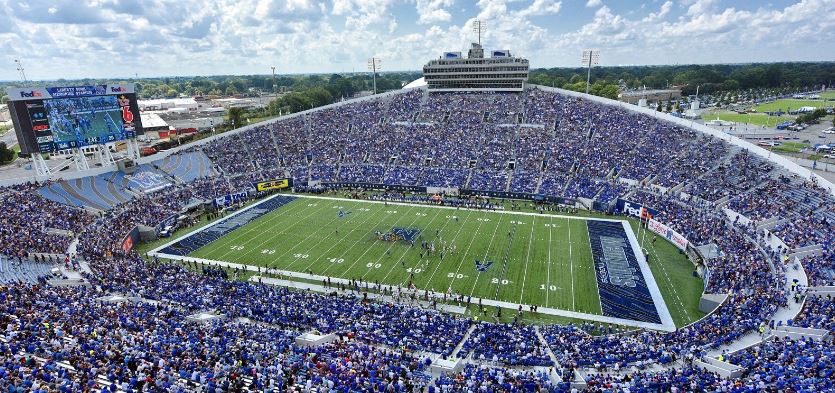
Perhaps one of the most well known venues because of the one game it hosts each year, the Liberty Bowl has been the site of many football games over the past five decades. In the early 1960s there was talk of building a new football stadium in Memphis at the Mid-South Fairgrounds in an effort to bring the Liberty Bowl game to the city. The stadium became a reality when construction began on the $3.7 million stadium in 1965. Not only did the stadium become the home of the annual Liberty Bowl game, but the Memphis Tigers moved to the facility when it was completed in 1967.
It was originally named after Memphis residents who served in World War I, World War II and the Korean War, but was later renamed Liberty Bowl Memorial Stadium in 1976. Like every other stadium, the Liberty Bowl has undergone several expansion projects throughout its history. Before the 1987 season, $19.5 million was spent on several expansions including the addition of luxury suites, 12,000 seats and a new stadium club. In 2005, $15 million was spent on general repairs to the stadium and installing Fieldturf, replacing the grass playing field.
In 2022, the Liberty Bowl was renamed Simmons Bank Liberty Stadium after the City of Memphis signed a 10 year, $6.82 million naming rights agreement with Simmons Bank.
In March 2024 the University of Memphis announced plans for a three-phased renovation project at the Liberty Bowl. At a cost of $226.5 million it was completed by the 2026 season. Both the east and west sides were renovated. The most dramatic update occurred on the west side as the existing stands were partially demolished and replaced with a new structure that houses premium seating options and a party plaza area for fans. It also includes a new videoboard, measuring 47′ x 114′. The new capacity of the stadium is 45,632.
Of course the stadium is most popular for hosting the annual Liberty Bowl game each year. The Liberty Bowl was also home of the Tennessee Oilers (NFL) during the 1997 after moving from Houston.